
Why Contract Manufacturing Is No Longer Just a Manufacturing Decision—It's a Business Growth Strategy
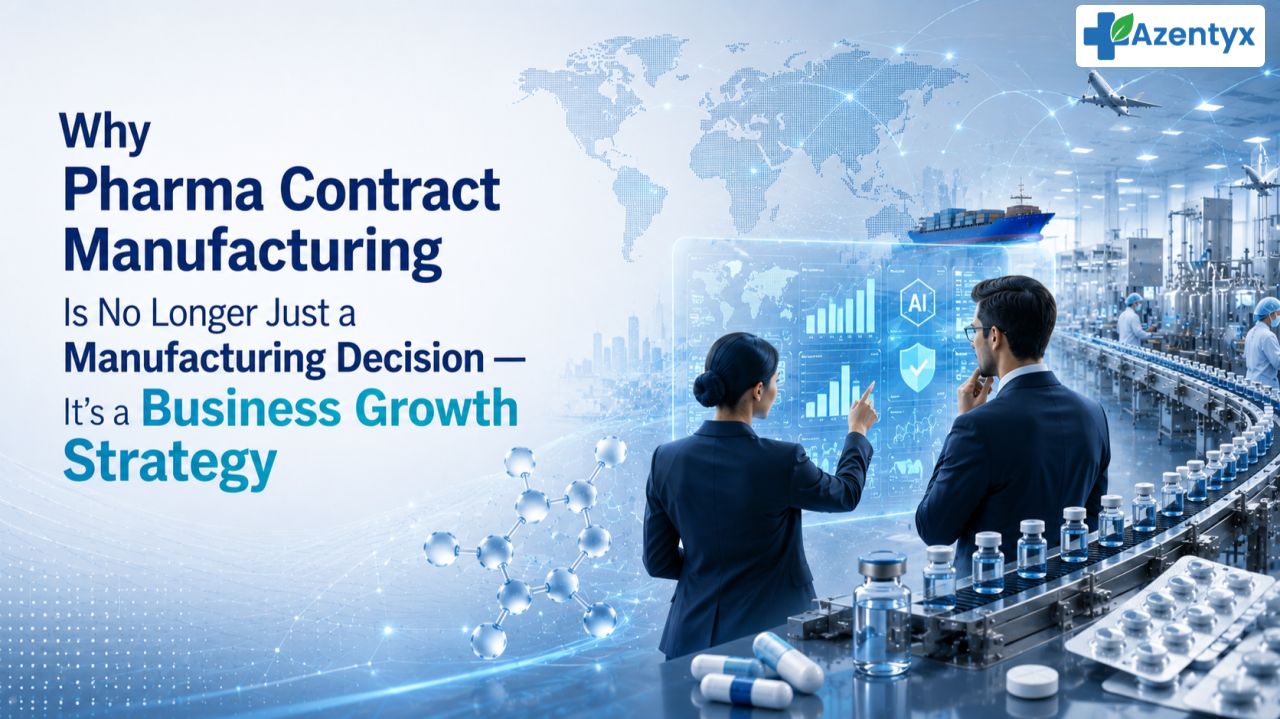
The Pharmaceutical Industry Is Entering a New Era
The pharmaceutical industry has never stood still.
Over the past few decades, we've witnessed remarkable advances in drug discovery, manufacturing technologies, quality systems, and regulatory frameworks. Yet perhaps the most significant transformation isn't happening inside laboratories or production facilities —it's happening in the boardrooms of pharmaceutical companies.
Evolution of Pharmaceutical Industry
For years, manufacturing was viewed as a symbol of capability. Owning production facilities meant greater control, higher capacity, and stronger market presence. Building manufacturing infrastructure was often considered a natural milestone in a company's growth journey.
Today, that mindset is changing.
Pharmaceutical leaders are no longer asking:
"Should we build another manufacturing plant?"
Instead, they're asking:
- How do we launch products faster?
- How do we scale without massive capital investments?
- How do we expand into global markets?
- How do we maintain world-class quality while staying agile?
- How do we focus more on innovation and less on operational complexity?
The answers to these questions increasingly point toward one strategy:
PHARMA CONTRACT MANUFACTURING.
Not because companies cannot manufacture.
But because they recognize that manufacturing is no longer merely an operational function—it has become a strategic business decision.
Why Contract Manufacturing Has Become a Strategic Decision
Manufacturing Has Become More Complex Than Ever
Modern pharmaceutical manufacturing extends far beyond producing tablets, capsules, or oral liquids.
Today's facilities must operate within an ecosystem of stringent regulatory expectations, validated manufacturing processes, sophisticated analytical laboratories, digital documentation systems, environmental monitoring, equipment qualification, supplier audits, serialization requirements, and data integrity practices.

Multiple interconnected capabilities working together in modern pharmaceutical manufacturing
Every batch manufactured carries the responsibility of patient safety.
Every process must withstand regulatory scrutiny.
Every document plays a critical role in compliance.
Building these capabilities requires years of investment—not only in infrastructure but also in highly skilled scientists, quality professionals, regulatory experts, and advanced technologies.
For many pharmaceutical companies, maintaining this level of operational excellence internally is no longer the most strategic use of resources.
Growth Requires More Than Manufacturing Capacity
Success in todays' pharmaceutical market depends on much more than production output.
Companies are expected to innovate continuously, launch products quickly, expand therapeutic portfolios, strengthen physician engagement, build stronger distribution networks, navigate complex regulatory pathways, and enter new international markets.

Manufacturing is one of the strategic capabilities that powers sustainable pharmaceutical business growth.
These priorities compete for management attention and financial resources.
Every rupee invested in manufacturing infrastructure is a rupee that cannot be invested elsewhere.
This has prompted many pharmaceutical companies to rethink where they create the greatest value.
Rather than investing heavily in factories, many are choosing to invest in innovation, commercialization, branding, exports, and customer relationships — while partnering with specialists for manufacturing.
This isn't outsourcing.
It's strategic resource allocation.
Why More Pharmaceutical Brands Are Choosing Contract Manufacturing

Why Pharma Contract Manufacturing Gaining Attention
Faster Time to Market
In pharmaceuticals, speed matters.
Launching a product six months ahead of competitors can influence market share, physician adoption, and long-term commercial success.
Establishing a manufacturing facility can take years, from construction and equipment installation to validation and regulatory approvals.
An experienced contract manufacturing partner already has validated infrastructure, trained technical teams, established quality systems, and commercial production capabilities.
Instead of building these foundations from scratch, pharmaceutical companies can move directly into formulation development, technology transfer, validation, and commercial production.
The result is significantly shorter development timelines and faster market entry.
Better Capital Allocation
Building a pharmaceutical manufacturing facility demands substantial capital investment.
Land acquisition, production equipment, cleanroom environments, HVAC systems, purified water plants, laboratories, warehousing, utilities, and validation collectively require significant financial commitment.
While these investments are essential for manufacturing, they may not generate the highest return on investment for every pharmaceutical company.
Today's successful businesses increasingly prefer to invest capital in activities that directly accelerate growth:
- Launching new brands
- Expanding into new therapeutic segments
- Building stronger sales networks
- Entering export markets
- Strengthening customer engagement
- Developing innovative formulations
Contract manufacturing enables companies to convert large capital expenditures into manageable operating expenses while preserving financial flexibility.
Access to Specialized Expertise
Pharmaceutical manufacturing is powered by expertise—not equipment alone.
Developing a robust formulation, validating manufacturing processes, maintaining regulatory compliance, ensuring batch consistency, and managing quality systems require multidisciplinary teams with years of practical experience.
Established contract manufacturers bring together formulation scientists, analytical chemists, microbiologists, production specialists, quality assurance professionals, regulatory experts, and supply chain teams under one roof.
This depth of expertise is difficult and time-consuming to replicate internally.
For pharmaceutical companies, partnering with experienced manufacturers provides immediate access to knowledge accumulated over decades.
Integrated CDMO Services
The role of contract manufacturers has expanded significantly.
Today's pharmaceutical companies increasingly prefer integrated partners capable of supporting every stage of the product lifecycle.
From formulation development and analytical method development to technology transfer, commercial manufacturing, packaging, stability studies, and regulatory documentation, integrated CDMO partners simplify project management while improving speed, consistency, and accountability.
Instead of coordinating multiple vendors, businesses benefit from working with one trusted partner.
The Business Advantages Beyond Cost Savings
For years, discussions around pharmaceutical contract manufacturing were largely centered on a single benefit—cost reduction.
While cost efficiency remains important, it is no longer the primary reason companies choose this model. Pharmaceutical leaders are looking beyond operational savings. They are evaluating how manufacturing partnerships can improve agility, strengthen resilience, reduce business risk, and accelerate growth.
In many ways, the value of contract manufacturing is no longer measured by what companies spend less—it is measured by what they gain more.

Pharma Contract Manufacturing - From Cost Savings to Business Value
Scalable Manufacturing That Grows With Your Business
Every pharmaceutical company dreams of launching a successful product. Yet one of the biggest operational challenges lies in predicting demand accurately.
Will the first production batch be sufficient? Will demand double after a successful launch? What happens if an export opportunity suddenly arises?
Owning manufacturing infrastructure often means investing for future demand that may or may not materialize. Excess capacity increases operating costs, while insufficient capacity can delay business opportunities.
Contract manufacturing offers a far more flexible approach.
Companies can begin with commercial batches that match current demand and scale production as their business grows. Whether introducing a single product or expanding an entire therapeutic portfolio, scalable manufacturing allows businesses to respond quickly without making significant infrastructure investments.
This flexibility has become a critical competitive advantage in dynamic pharmaceutical market.
Stronger Regulatory Readiness
Regulatory compliance has become increasingly complex across domestic and international markets.
Health authorities expect pharmaceutical manufacturers to maintain validated processes, robust documentation, comprehensive quality management systems, analytical testing capabilities, data integrity, equipment qualification, and complete batch traceability.
Developing and maintaining these systems internally requires continuous investment and dedicated expertise.
Experienced contract manufacturers already operate within this regulatory environment every day. They understand inspection readiness, documentation practices, validation requirements, change control procedures, deviation management, and evolving compliance expectations.
For pharmaceutical companies, this significantly reduces regulatory risk while ensuring greater confidence during audits, product registrations, and market expansion.
Building Supply Chain Resilience
The COVID-19 pandemic fundamentally changed how businesses think about supply chains.
In today's market, reliable manufacturing extends far beyond production capacity.
It depends on dependable sourcing of APIs, excipients, packaging materials, qualified suppliers, inventory planning, logistics coordination, and contingency planning.
Established contract manufacturers have spent years developing resilient supplier networks and procurement systems that help minimize disruptions.
Their experience in vendor qualification, inventory management, alternate sourcing strategies, and production planning enables pharmaceutical companies to maintain continuity even during uncertain market conditions.
In today's environment, supply chain resilience is not merely an operational requirement—it is a strategic business asset.
Quality Is No Longer a Competitive Advantage—It Is the Minimum Expectation
There was a time when exceptional quality differentiated one manufacturer from another.
Today, quality is simply expected.
Patients expect safe medicines.
Healthcare professionals expect consistent performance.
Regulators expect complete compliance.
Pharmaceutical brands expect every batch to meet the same high standards.
Quality is no longer something companies advertise—it is something they must consistently deliver.
Leading contract manufacturers understand this reality.
They invest continuously in analytical laboratories, in-process quality controls, environmental monitoring, equipment validation, employee training, supplier qualification, and continuous improvement initiatives.
The result is more than regulatory compliance.
It is confidence.
Confidence that every batch reflects the quality standards upon which pharmaceutical brands build their reputation.
Export Readiness Opens New Markets
Global expansion has become a key growth strategy for many pharmaceutical companies.
However, entering international markets involves far more than manufacturing medicines.
Different countries require different regulatory submissions, documentation standards, stability data, packaging requirements, labeling regulations, and quality expectations.
Working with an export-ready manufacturing partner significantly simplifies this process.
Manufacturers experienced in international business understand the documentation, compliance frameworks, and operational discipline required for global markets.
For pharmaceutical companies planning to expand internationally, this expertise reduces both complexity and time to market.
A capable manufacturing partner doesn't simply help produce medicines—they help businesses reach new markets with confidence.
Why India Has Become a Preferred Contract Manufacturing Hub
India's reputation as a pharmaceutical manufacturing destination has evolved dramatically over the past two decades.
While competitive manufacturing costs initially attracted global attention, India's true strength today lies in the maturity of its pharmaceutical ecosystem.
It combines scientific expertise, regulatory experience, manufacturing excellence, and large-scale production capabilities in a way few countries can match.

India is enabling global pharmaceutical innovation, quality, and supply resilience for the world
This evolution has transformed India from a cost-efficient manufacturing destination into a trusted global pharmaceutical partner.
A Highly Skilled Scientific Workforce
Behind every successful pharmaceutical product is a team of formulation scientists, analytical chemists, microbiologists, production engineers, quality professionals, and regulatory specialists.
India possesses one of the world's largest pools of pharmaceutical talent, supported by decades of experience across generics, specialty medicines, nutraceuticals, and export-focused manufacturing.
This depth of expertise enables manufacturers to support not only production but also formulation development, process optimization, technology transfer, and continuous product improvement.
Globally Compliant Manufacturing Infrastructure
Indian pharmaceutical manufacturers have made substantial investments in modern infrastructure, automation, quality systems, and regulatory compliance.
Today, numerous facilities operate according to internationally recognized manufacturing standards while supplying products to regulated and semi-regulated markets worldwide.
For pharmaceutical companies seeking dependable manufacturing partners, India offers an extensive network of facilities capable of meeting diverse market requirements.
A Strong Supplier Ecosystem
Successful pharmaceutical manufacturing depends on far more than production equipment.
Reliable access to active pharmaceutical ingredients, excipients, packaging materials, logistics providers, testing laboratories, and technical service providers forms the backbone of efficient operations.
India's well-developed pharmaceutical ecosystem enables manufacturers to source materials efficiently, maintain competitive lead times, and respond quickly to changing customer requirements.
This integrated ecosystem strengthens both operational efficiency and supply chain reliability.
Cost Efficiency Without Compromising Quality
One of India's greatest strengths is its ability to deliver exceptional value—not simply lower costs.
Efficient manufacturing processes, skilled manpower, established supplier networks, and economies of scale allow manufacturers to maintain competitive pricing while meeting stringent quality expectations.
For pharmaceutical companies, this creates an attractive balance between affordability, quality, and reliability.
The conversation is no longer about finding the cheapest manufacturing destination.
It is about finding the best long-term value.
India's Evolution Into a Global CDMO Destination
Perhaps the biggest transformation has been India's movement beyond conventional third-party manufacturing.
Today, many Indian pharmaceutical companies offer integrated Contract Development and Manufacturing Organization (CDMO) services.
These include formulation development, analytical method development, stability studies, technology transfer, commercial manufacturing, packaging, and regulatory documentation.
This integrated approach simplifies product development while allowing pharmaceutical companies to work with a single strategic partner throughout the product lifecycle.
As a result, India is increasingly being viewed not merely as a manufacturing destination—but as a global innovation and development partner.
Choosing the Right Contract Manufacturing Partner
Selecting a contract manufacturing partner is one of the most important strategic decisions a pharmaceutical company can make. While pricing often dominates initial discussions, the true value of a manufacturing partnership extends far beyond commercial terms.
A manufacturing partner influences product quality, regulatory compliance, supply reliability, speed to market, customer satisfaction, and ultimately, the reputation of your brand.
The right partnership can accelerate business growth.
The wrong one can create delays, quality issues, regulatory challenges, and lost market opportunities.
So, what should pharmaceutical companies look for?
There are 7 essential factors every pharmaceutical company should evaluate before selecting a contract manufacturing partner. These are:
- Dedicated Formulation & Development (F&D) Facility
- State-of-the-Art Testing Laboratory
- Quality & Compliance
- Manufacturing Capabilities
- Experience & Expertise
- Documentation & Transparency
- Partnership & Support
Whether you're launching a new product or expanding your portfolio, the right manufacturing partner can become a strategic advantage—not just a supplier.
Common Mistakes Companies Make
Despite the growing importance of strategic partnerships, many pharmaceutical companies continue to make avoidable mistakes when selecting manufacturers.
Understanding these pitfalls can save significant time, cost, and operational disruption.
Choosing Only on Price
The lowest quotation is not always the lowest overall cost.
Lower manufacturing costs can sometimes lead to quality issues, delayed deliveries, regulatory observations, supply interruptions, or expensive product recalls.
When evaluating manufacturing partners, businesses should focus on overall value rather than price alone.
Ignoring Technical Capabilities
A manufacturing facility may appear impressive during a site visit.
However, true capability lies in technical expertise.
Companies should carefully assess formulation development capabilities, analytical laboratories, validation systems, quality teams, production processes, and regulatory support before making a decision.
Infrastructure alone does not guarantee manufacturing excellence.
Overlooking Future Scalability
A manufacturing partner may satisfy today's production requirements but struggle to support tomorrow's growth.
Businesses should evaluate whether the manufacturer has sufficient production capacity, infrastructure, technical manpower, and expansion capability to accommodate future product launches and increased demand.
Growth should never outpace manufacturing capability.
Treating Manufacturers as Vendors Instead of Partners
Perhaps the biggest mistake is viewing manufacturing as a transactional relationship.
The strongest pharmaceutical businesses build collaborative partnerships based on trust, shared objectives, continuous improvement, and long-term commitment.
When manufacturers understand a client's business strategy—not just their purchase orders—they become valuable contributors to sustained growth.
The Future of Pharmaceutical Contract Manufacturing
The pharmaceutical industry continues to evolve rapidly.
The manufacturers that succeed over the next decade will be those who continuously invest in technology, people, quality systems, and innovation.
Several trends are already reshaping the future.
Digital Manufacturing
Manufacturing operations are becoming increasingly connected through digital technologies.
Electronic batch records, real-time production monitoring, predictive maintenance, digital quality management systems, and integrated manufacturing execution systems are improving efficiency while reducing operational risk.
Digital transformation is no longer optional. It is becoming the industry standard.
Artificial Intelligence in Manufacturing
Artificial Intelligence is beginning to transform pharmaceutical operations.
From predictive quality analysis and equipment maintenance to demand forecasting, document management, and supply chain optimization, AI is enabling smarter manufacturing decisions.
Rather than replacing expertise, AI is enhancing human decision-making through better insights and faster analysis.
Sustainability Is Becoming a Business Imperative
Environmental responsibility is no longer simply a corporate initiative.
Customers, regulators, and global markets increasingly expect pharmaceutical manufacturers to adopt sustainable manufacturing practices.
Energy-efficient facilities, water conservation, responsible waste management, environmentally conscious packaging, and optimized production processes are becoming integral components of modern pharmaceutical operations.
Sustainability is evolving into both a regulatory expectation and a competitive differentiator.
Personalized Medicine Will Demand Greater Flexibility
As personalized medicine, specialty therapies, and targeted treatments continue to expand, manufacturers will need to become more flexible.
Smaller production batches, specialized formulations, and shorter development cycles will require manufacturing partners capable of adapting quickly without compromising quality.
Flexibility will become as important as capacity.
Rising Regulatory Expectations
Regulatory standards will continue becoming more rigorous.
Manufacturers will need stronger documentation, improved data integrity, enhanced analytical capabilities, greater process validation, and continuous quality improvement.
Organizations that proactively strengthen compliance today will be better positioned for tomorrow's regulatory landscape.
Final Thoughts
The pharmaceutical industry is entering one of the most transformative periods in its history.
*Innovation is accelerating.
*Healthcare demands are evolving.
*Regulatory expectations continue to rise.
*Competition is becoming increasingly global.
In this environment, manufacturing can no longer be viewed as an isolated operational function.
It has become a strategic driver of business performance.
The pharmaceutical companies that will lead the next decade may not be those with the largest manufacturing facilities.
They will be the organizations that make smarter decisions about where to invest, where to innovate, and where to collaborate.
Contract manufacturing is no longer about simply outsourcing production.
It is about building resilience.
Accelerating innovation.
Improving agility.
Managing risk.
Creating sustainable growth.
And most importantly, delivering safe, effective, and high-quality medicines to the patients who depend on them.
For pharmaceutical companies evaluating their next phase of growth, the question is no longer:
"Should we outsource manufacturing?"
The more important question is:
"Are we choosing a manufacturing partner that can help shape the future of our business?"
At Azentyx, we believe that contract manufacturing is built on more than infrastructure and production capacity. It is built on scientific expertise, uncompromising quality, regulatory excellence, transparency, and a shared commitment to long-term success. As pharmaceutical businesses grow and markets evolve, the right manufacturing partner doesn't simply produce medicines—it helps build stronger brands, unlock new opportunities, and create lasting value.

Azentyx - Your Trusted Partner in Pharmaceutical Contract Manufacturing
Whether you're launching a new product, expanding your portfolio, or exploring new markets, Azentyx is committed to being your trusted manufacturing partner every step of the way.
Connect with us to discuss your manufacturing requirements:
🌐 Website: www.azentyx.com
📧 Email: info@azentyx.com