
Why Building a Pharma Factory Isn't Always the Smartest Investment
Every strategic investment carries an opportunity cost. In pharmaceutical manufacturing, few decisions have a greater influence on long-term growth than deciding whether to build manufacturing infrastructure—or partner with an established contract manufacturer.
A manufacturing facility creates a visible asset. It signals scale, control and long-term intent. Yet it also commits capital to land, buildings, utilities, equipment, validation, technical teams, quality systems and ongoing compliance—often years before the facility reaches stable utilisation.
A strategic manufacturing partnership creates a different type of value. It gives a pharmaceutical business access to established infrastructure and specialised expertise while preserving capital for product development, portfolio expansion, marketing, distribution and market entry.
The economic question is therefore not simply whether owning a factory is preferable to outsourcing production.
It is:
Where can each unit of capital create the greatest long-term value for the business?
That question is turning pharmaceutical contract manufacturing from a procurement decision into a boardroom strategy.
Manufacturing Is a Capital-Allocation Decision
Pharmaceutical manufacturing is often discussed as an operational capability. Economically, however, it is also a capital-allocation choice.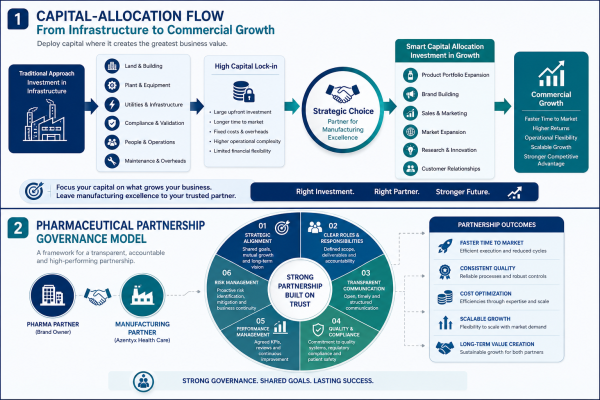
A company that builds its own facility must commit resources well before the first commercial batch is produced. Expenditure extends beyond construction and production machinery. It includes environmental controls, utilities, laboratories, material-handling systems, documentation infrastructure, validation, maintenance systems, technical recruitment and the quality organisation required to operate the site.
These investments may be strategically justified where a company requires proprietary technology, highly specialised capacity, supply-chain sovereignty or consistent demand at sufficient scale.
However, ownership does not automatically translate into economic advantage.
Capital invested in infrastructure cannot simultaneously be deployed towards acquiring customers, developing new formulations, entering new geographies or strengthening a commercial organisation. The real cost of a factory is therefore not only the amount spent on the factory. It is also the business opportunities postponed, reduced or abandoned because capital was committed elsewhere.
This is the first principle of third-party manufacturing economics:
The cost of infrastructure includes the growth that the same capital might otherwise have funded.
For a pharmaceutical business, this distinction matters because competitive advantage is rarely created by one function alone. Manufacturing must work alongside product strategy, regulatory capability, distribution, brand development and customer relationships.
An organisation can possess an excellent facility and still struggle commercially if too little capital remains available to build demand.
Converting Fixed Commitments into Scalable Capacity
The clearest financial distinction between owned and outsourced manufacturing lies in the structure of costs.
An owned facility creates a substantial fixed-cost base. Depreciation, salaries, utilities, maintenance, calibration, validation and compliance expenses continue even when production volumes are below expectations.
Third-party manufacturing transforms a significant portion of fixed investment into a more flexible operating model. The company purchases qualified capacity in line with product requirements rather than financing an entire manufacturing system independently.
This does not mean outsourced manufacturing is automatically inexpensive. A capable pharmaceutical contract manufacturing partner must recover the cost of its infrastructure, expertise, compliance systems and commercial risk. The strategic benefit lies elsewhere: the client avoids carrying the full cost and utilisation risk of dedicated assets.
The economic value becomes particularly clear when demand is uncertain.
A new product may exceed expectations, develop slowly or require reformulation. A new market may take longer to enter than anticipated. A portfolio may shift as commercial priorities change. When capacity is owned, the company remains economically tied to the original investment. When capacity is accessed through a manufacturing partner, the business has greater room to adapt.
This makes contract manufacturing especially relevant for companies managing:
- new product launches;
- expanding or changing portfolios;
- multiple dosage forms;
- fluctuating demand;
- entry into unfamiliar markets; and
- businesses that want to scale without accumulating excessive fixed costs.
The central benefit is not the elimination of cost.
It is the reduction of irreversible cost.
Faster Commercialisation Has Economic Value
Time is one of the least visible but most important variables in pharmaceutical manufacturing economics.
Developing an owned facility requires planning, construction, installation, qualification, validation, recruitment, licensing and regulatory readiness. Even after commissioning, processes and teams need time to stabilise.
An established manufacturing partner already possesses much of this operating platform.
That can reduce the period between commercial decision and market availability, subject to product development, technology transfer, regulatory and capacity requirements.
The benefit is not merely operational convenience. Earlier market entry may allow a company to begin generating revenue sooner, build distributor relationships earlier, respond more quickly to demand and learn from real market performance before competitors.
Delays have economic consequences. They can lead to:
- missed market windows;
- slower revenue generation;
- weakened distributor confidence;
- delayed portfolio expansion; and
- capital remaining unproductive for longer.
For this reason, time-to-market should be treated as part of return on investment—not simply as a project-management metric.
A manufacturer that offers a lower quoted cost but repeatedly delays launches may be economically more expensive than a partner with stronger planning, documentation and execution.
In pharmaceutical manufacturing, speed without compliance is dangerous—but compliance without execution can also destroy value.
The strongest partners balance both.
Outsourcing Does Not Outsource Responsibility
One of the most damaging misconceptions about third-party pharmaceutical manufacturing is that contracting out production transfers responsibility away from the product owner.
It does not.
Regulators treat contracted activities as part of the wider pharmaceutical quality system. The US Food and Drug Administration states that parties involved in contract drug manufacturing should clearly define and document their respective manufacturing and quality responsibilities through quality agreements. FDA guidance also emphasises that contract facilities remain subject to current good manufacturing practice requirements.
WHO describes GMP as the part of quality management that ensures pharmaceutical products are consistently produced and controlled according to appropriate quality standards. Its framework covers production, quality control, documented procedures, validated processes, suitable premises, trained personnel and responsibilities associated with contract manufacturing and testing.
The economic implication is important.
A weak outsourcing relationship may appear asset-light but can create substantial hidden exposure through:
- unclear responsibilities;
- poor documentation;
- inconsistent communication;
- delayed investigations;
- weak change control;
- supply disruptions;
- rejected batches;
- regulatory findings; and
- reputational damage.
Third-party manufacturing reduces the need to own infrastructure. It does not reduce the need for governance.
The right operating model therefore includes:
- technical and quality due diligence;
- clearly defined quality agreements;
- approved specifications;
- documented communication channels;
- change-control procedures;
- deviation and CAPA governance;
- performance reviews;
- audit rights; and
- escalation mechanisms.
The relationship must be managed as a strategic operating partnership, not as a transactional purchase order.
The Hidden Costs of Manufacturing Ownership
Factory construction is visible. The ongoing cost of maintaining pharmaceutical readiness is less visible.
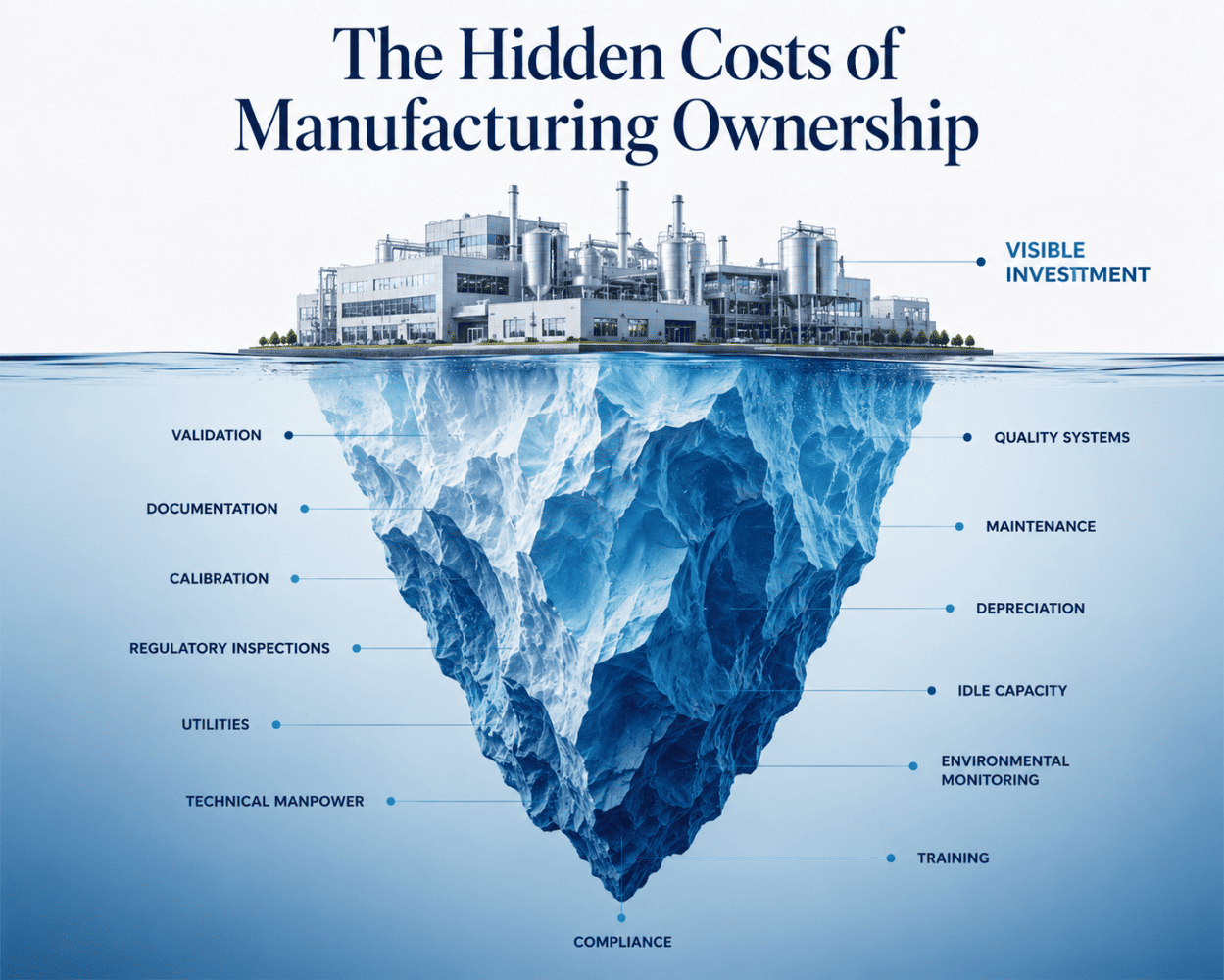
A compliant site must continuously support systems relating to:
Equipment and facilities
Production equipment must be maintained, calibrated and, where appropriate, qualified. Utilities and environmental systems require monitoring and upkeep. Ageing infrastructure can demand upgrades even when commercial demand has not increased.
Validation
Processes, cleaning procedures, analytical methods and systems must remain in a state of control. Validation is not a one-time commissioning exercise. It forms part of the product and process lifecycle.
ICH Q10 describes a pharmaceutical quality system that spans the product lifecycle and links development, technology transfer, commercial manufacturing and product discontinuation. It places continual improvement and management responsibility at the centre of pharmaceutical quality.
Technical talent
Manufacturing requires qualified professionals across production, quality assurance, quality control, engineering, warehousing, regulatory affairs and documentation. Recruitment is only the beginning. Training, retention, succession and continuous capability development also carry cost.
Regulatory readiness
Inspections are not isolated events. A well-managed facility must remain inspection-ready through disciplined execution, accurate records and effective oversight.
Capacity utilisation
Underused capacity can become an economic burden. A plant designed for future demand may operate below optimum utilisation for years, while fixed costs continue.
This creates a paradox: a company may own valuable infrastructure while simultaneously suffering from poor capital productivity.
A third-party manufacturer aggregates demand across customers and products. That can improve asset utilisation at the manufacturing level, while allowing each client to access capacity without carrying the economics of the entire site.
Beyond Cost Reduction: The Strategic Case
Reducing infrastructure expenditure is only one part of the case for third-party manufacturing.
The more significant advantage is strategic focus.
A pharmaceutical company cannot treat every function as its primary differentiator. It must decide where it can create distinctive value and where specialised partners may be better positioned to deliver operational capability.
For some businesses, advantage lies in formulation strategy. For others, it may lie in market access, physician relationships, distribution, exports, brand building or portfolio selection.
A strong contract manufacturing model allows management to concentrate financial and organisational resources on these areas.
Capital preserved through outsourcing can be redirected towards:
- developing or acquiring new products;
- expanding into additional therapeutic categories;
- building sales teams;
- strengthening distributor networks;
- improving demand forecasting;
- entering export markets;
- investing in regulatory submissions;
- accelerating digital engagement; and
- improving customer service